



Can LLMs Lead to AGI – Most Misunderstood Question in AI
By Divya Rakesh, Though Leader in Data & Artificial Intelligence, 6 Nov 2025
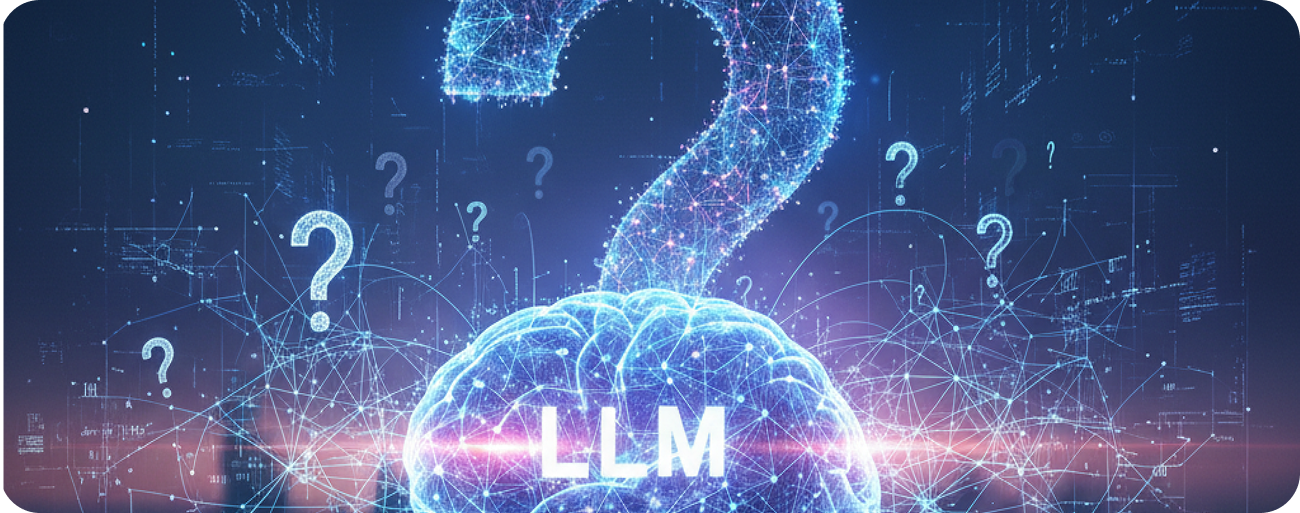
Over the past year, I’ve had countless discussions with peers and researchers around one question that refuses to fade — can Large Language Models (LLMs) truly lead us to Artificial General Intelligence (AGI)?
With the rise of GPT-4, Claude, Gemini, and others, it’s easy to believe we’re already halfway there. The models write, reason, code, even “converse” with empathy. But beneath the surface, the architecture that powers them — transformer-based, text-prediction engines — has inherent limitations that may prevent it from ever reaching true general intelligence.
Let me explain why, and where I think the real breakthroughs may lie.
What Makes AGI Fundamentally Different
AGI, by definition, isn’t just about performing diverse tasks — it’s about understanding, adapting, and reasoning in ways comparable to human cognition. It requires:
- Grounded experience — a sense of the physical or digital world it interacts with, not just statistical correlations.
- Persistent memory — learning continuously from new events and retaining context over time.
- Autonomous reasoning — the ability to plan, infer causality, and pursue goals.
- Self-reflection — awareness of its own decisions and limits.
LLMs, for all their brilliance, were not designed for any of these.
Where LLMs Shine — and Where They Hit a Wall
LLMs are phenomenal pattern recognizers. They compress knowledge from vast corpora of text into probabilistic relationships, producing language that often feels intelligent. That’s why they’re so useful in knowledge work, summarization, and creative assistance.
That meeting made me realize that data storytelling isn’t just a nice-to-have skill — it’s the bridge between analytics and But they lack grounding — they don’t see, hear, or act. They have no concept of time or causality. They don’t build or update a model of the world; they predict the next token based on past patterns. Even when they “reason,” it’s an illusion of reasoning — the model has learned patterns of reasoning language, not reasoning itself.
Scaling LLMs further (more data, bigger models) will yield smarter assistants — but likely not conscious, autonomous, or self-learning entities. As we’ve seen, performance improvements from scaling are now diminishing.
What Might Be Needed Instead
The path toward AGI will likely demand hybrid architectures — combining what LLMs do best (language and pattern learning) with elements they lack:
- Neurosymbolic systems for structured reasoning and logical consistency.
- World models to simulate environments and learn from interactions.
- Memory-augmented networks for long-term understanding and continual learning.
- Embodied or multimodal agents that perceive, act, and learn from feedback loops — not just text.
- Brain-inspired systems that integrate perception, action, and memory efficiently.
In essence, LLMs could become the “linguistic cortex” of a broader AGI framework — but they won’t be the whole brain.
The Balanced View
Some experts — like Sam Altman or Andrej Karpathy — remain optimistic that with enough scaffolding (tools, memory, sensors), LLMs could evolve into AGI-like systems. Others — including Yann LeCun and Gary Marcus — argue that prediction-based learning will always lack the grounding, causality, and abstraction needed for general intelligence.
Personally, I lean toward the latter camp. LLMs represent a powerful milestone — a remarkable proof that language and knowledge can be compressed into computation. But intelligence is more than language. It’s interaction, reflection, curiosity, and experience — things that transformers, by design, cannot yet achieve.
My Takeaway
LLMs are the engine of today’s GenAI revolution, but AGI will need an architecture of architectures — one that combines learning, reasoning, perception, and memory in an integrated way. We are witnessing an exciting time where these ideas are converging — neurosymbolic AI, world models, and brain-inspired computing are all evolving rapidly.
LLMs are the engine of today’s GenAI revolution, but AGI will need an architecture of architectures — one that combines learning, reasoning, perception, and memory in an integrated way. We are witnessing an exciting time where these ideas are converging — neurosymbolic AI, world models, and brain-inspired computing are all evolving rapidly.
What’s your view? Can transformers evolve beyond their statistical roots — or do we need to rethink intelligence from the ground up?
Disclaimer: The stories and opinions shared here are meant to inform and inspire. They reflect individual experiences and viewpoints, not necessarily those of VCreaTek. While every effort is made to ensure accuracy, VCreaTek is not responsible for any errors or outcomes arising from the use of this information.
From Analyst to Storyteller
Transitioning from data analyst to data storyteller doesn’t mean abandoning your analytical rigor. It means layering communication on top of it.
Here are a few habits that help:
- Start with questions, not datasets. Ask “What do we want to learn?” before diving into the data.
- Use visuals with intention. Each chart should serve a narrative purpose, not just aesthetic appeal.
- Practice empathy. Imagine you’re explaining the insight to someone outside your domain.
- End with a call to action. Every insight should point toward a decision, not just observation.
Closing Thoughts: Let Your Data Speak
Think of data storytelling as teaching your data to speak human.
When you combine analytical accuracy with narrative clarity, your insights don’t just inform — they influence.
The next time you open Power BI or Excel, don’t just ask, “What does the data say?”
Ask, “What story does it want to tell?”
That’s when your numbers truly start making an impact.
Disclaimer: The stories and opinions shared here are meant to inform and inspire. They reflect individual experiences and viewpoints, not necessarily those of VCreaTek. While every effort is made to ensure accuracy, VCreaTek is not responsible for any errors or outcomes arising from the use of this information.