






Data Storytelling: When Numbers Start Speaking
By Amey Oak, Thought Leader in Data Analysis, 5 Nov 2025
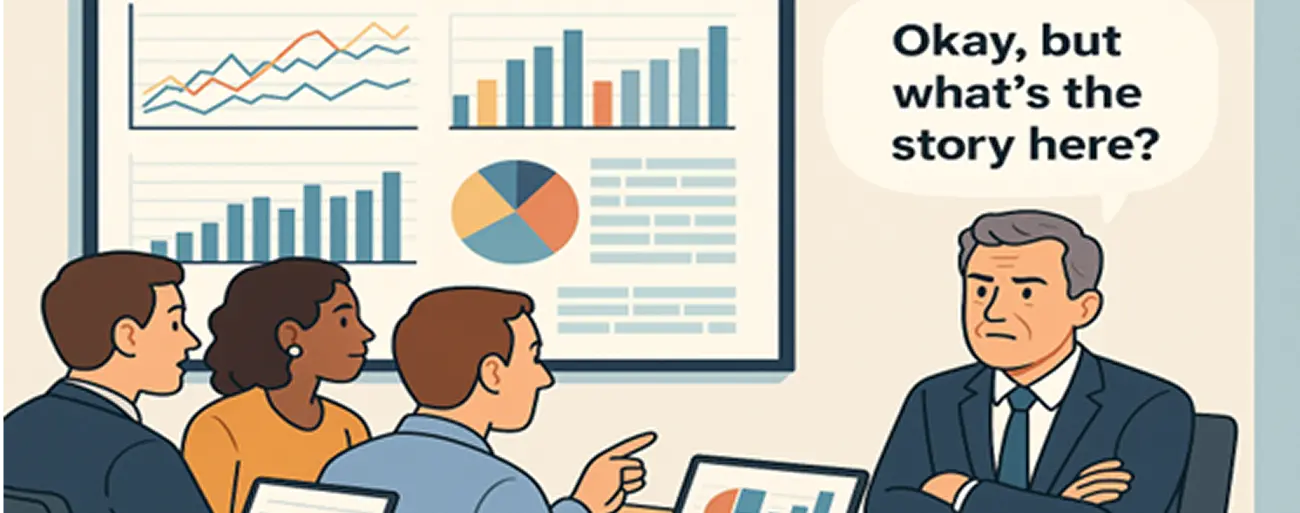
A few months ago, during a project review, our team was presenting a dashboard packed with KPIs, charts, and graphs. We had everything : sales trends, customer insights, inventory movements, forecasts , all perfectly visualized.
But when we finished, the client paused and asked,
“Okay, but what’s the story here?”
That one question changed the way I looked at data presentations forever.
The Moment of Realization
For most analysts, data is our comfort zone — clean, structured, logical. We speak in averages, variances, and percentages. But for decision-makers, numbers without meaning are just noise. They want narratives, not numbers. They want to understand why something happened and what to do next.
That meeting made me realize that data storytelling isn’t just a nice-to-have skill — it’s the bridge between analytics and action.
So, What Exactly Is Data Storytelling?
- Data gives credibility — it’s the backbone.
- Visualization makes it digestible — it helps people “see” the insight.
- Storytelling makes it memorable — it’s what stays with the audience.
The Coffee Machine Lesson
Let me share a simple analogy. Imagine you walk into your office pantry and notice that the coffee machine is always empty by 11 a.m. You look at the data and find that coffee consumption has gone up by 30%.
That’s an interesting insight — but it’s not a story yet.
Now, what if you dig deeper and realize that a new team has joined recently, working night shifts, and they prefer strong coffee to stay alert? You connect the dots, and now you have a narrative:
“Since the new shift started, coffee demand has increased by 30%. We might need a second machine or a better refilling schedule to ensure availability for both shifts.”
Suddenly, your data doesn’t just state a fact — it drives a decision. That’s the power of storytelling.
The Three Elements of Great Data Stories
Every compelling data story has three ingredients — Context, Connection, and Conclusion.
Common Mistake: Drowning in Dashboards
We often assume that the more visuals we show, the more “data-driven” our presentation looks. But here’s a truth I’ve learned over time:
“A good data story doesn’t show all the data. It shows the right data.”
A single chart that clearly explains a trend can often be more powerful than ten graphs squeezed into a dashboard.
If your audience remembers only one key message from your presentation, you’ve told a good story.
From Analyst to Storyteller
Transitioning from data analyst to data storyteller doesn’t mean abandoning your analytical rigor. It means layering communication on top of it.
Here are a few habits that help:
- Start with questions, not datasets. Ask “What do we want to learn?” before diving into the data.
- Use visuals with intention. Each chart should serve a narrative purpose, not just aesthetic appeal.
- Practice empathy. Imagine you’re explaining the insight to someone outside your domain.
- End with a call to action. Every insight should point toward a decision, not just observation.
Closing Thoughts: Let Your Data Speak
Think of data storytelling as teaching your data to speak human.
When you combine analytical accuracy with narrative clarity, your insights don’t just inform — they influence.
The next time you open Power BI or Excel, don’t just ask, “What does the data say?”
Ask, “What story does it want to tell?”
That’s when your numbers truly start making an impact.
Disclaimer: The stories and opinions shared here are meant to inform and inspire. They reflect individual experiences and viewpoints, not necessarily those of VCreaTek. While every effort is made to ensure accuracy, VCreaTek is not responsible for any errors or outcomes arising from the use of this information.